

Fering Technologies, your through life mobility partners
Working with end users from countries around the world, Fering Technologies, and the Pioneer X, aim to become a through-life mobility partner.
A short walk down the River Thames from the Battersea Power Station, and just a five minute drive from Clapham Junction, a team of engineers are working on redefining land platform mobility. They’re using an industrial warehouse, not dissimilar to many others that house the UK’s defence industry, but this one – in the heart of London – makes for a powerful reminder of the growing importance of small to medium enterprises in British defence. The company is Fering Technologies, founded in 2019 by Ben Scott-Gedes, a former engineer at Ferrari and McLaren, he specialises in lightweight composite materials and their use in vehicle design. Ben started designing the company’s core product, Pioneer X, in his back garden during the COVID lockdowns. It was launched in January 2025 at the International Armoured Vehicles conference in Farnborough, a launch pad that has had enormous impact for the company, resulting in extensive customer interest. Working with those end users from countries around the world, Fering aims to become a through-life mobility partner.
Already, the company’s platform is being considered by 11 militaries around the world as armed forces look to replace their aging fleets with something that provides greater range and adaptability, as well as a 1:1 payload. And, with the introduction of US investment, Fering Technologies looks set to take its products to the US.
The Pioneer X brings three key strengths (and many others) that are applicable to almost any armed force. The first and most prominent is its range, but why? What does a 7,000 km range mean for a vehicle?
To Istanbul (and back again)
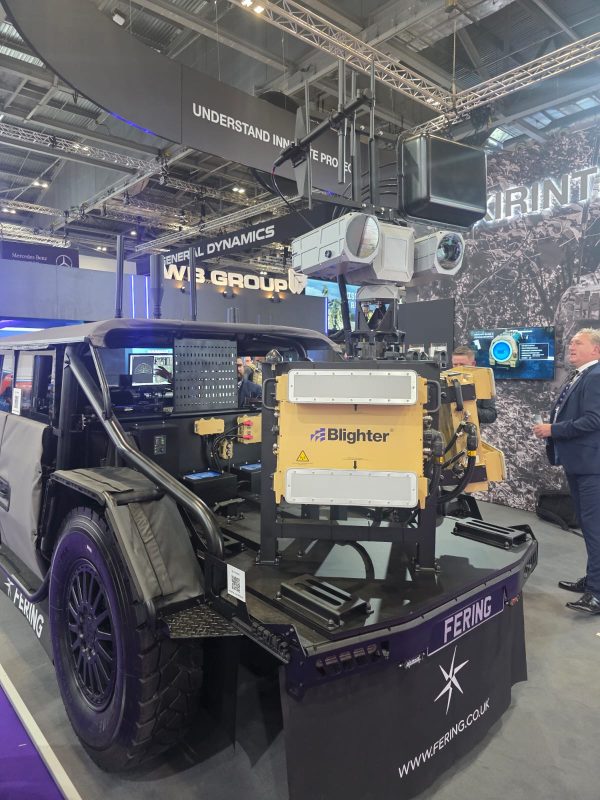
The Fering Pioneer X configured with Kirinetic’s electronic warfare systems. Credit: Fering Technologies
The Pioneer X is powered by a 60 kW multi-fuel (petrol, diesel, and JP3) generator with two electric motors, each generating 600 Nm of torque. For reference, a typical family SUV might generate only 250 Nm of torque, while a muscle car with V8 engine will be in the realms of 500 to 700 Nm. This is the kind of immediate power – 100% of which is available without having to accelerate – that would press you back into your seat. The multi-fuel generator is fed by a 470 litre fuel tank, which is where the Pioneer X gets its 7,000 km range. That is enough to drive from the Fering Technologies HQ in Battersea to Istanbul and back. It would be enough fuel to drive around the entire border of Afghanistan or Saudi Arabia. The company is also working on a hydrogen-fuelled version of the Pioneer X under a UK government grant and partnership with the Advanced Propulsion Centre.
This opens up new possibilities for armed forces, and especially special forces units. Consider a typical driving profile for light patrol vehicles of which there are many in a similar class. But the cruising range – implying a flat road and consistent speed – is rarely more than 800 km. This is a little over a tenth of the range of the Pioneer X, which would mean almost daily refueling of the platform. No big deal, you might say, but resupplying special operations units often requires a helicopter. If we look to Yemen, Syria, and Iraq, several Apache AH-64s in service with Saudi Arabia have been shot down by the Houthis in Yemen, and it is now fairly common for militias to bring down large drones like the MQ-9 with surface-to-air missiles. Anything that can hit an MQ-9 can very likely hit a UH-60 Black Hawk or CH-47 Chinook. This means that resupplying special forces units on future deployments could carry much higher risk, and minimising that need for resupply has immense potential value. “Any time you are operating deep behind an enemy’s frontline, you are at risk. And the risk to the operation increases by deploying more capability – like helicopters – across the FLOT. These things are always fraught with difficulty, but a vehicle that puts fewer people in harm’s way can only be a good thing,” James Bashall, a retired Lieutenant General from the British Army and Non-Executive Director at Fering told Calibre Defence.
“Any time you are operating deep behind an enemy’s frontline, you are at risk. And the risk to the operation increases by deploying more capability – like helicopters – across the FLOT. These things are always fraught with difficulty, but a vehicle that puts fewer people in harm’s way can only be a good thing.”
A new variant of the platform called XP 3 is being displayed on the ISTEC stand, kitted out in an imagined raiding role, with a 12.7 mm heavy machine gun and commanders GPMG. Even with that loadout, the flatbed remains empty allowing space for mission specific resupply, or other applications. The Pioneer X has a number of other capabilities designed to reduce the logistics burden at the edge. Fering Technologies has designed a Mission Specific Module Resupply System; a set of modules which carry all of the equipment a team might need, and are built to fit onto the Pioneer X. This means a helicopter would need to land for a matter of minutes, allowing the team to exchange modules and both vehicles to leave the area. In addition, the generator can run on any heavy fuel like diesel, even cooking oil, and the 22 inch tyres used are a universal size found on trucks around the world. The four batteries can also provide 80 km of silent driving, plenty for the final approach to an objective, reducing the battlefield signature and making the vehicle and crew more difficult to detect.
Plenty of power
The 60 kW engine provides much more than propulsion, it can off-board its power to run electrical systems in the field. Naturally, this allows ample power for all of the things a unit deployed in austere environments would need; radios, navigation, counter-drone suite, drones, electric motorbikes, and other weapon systems. But Pioneer X is built to be more than that. The batteries, which are based on a lithium titanate oxide chemistry can be dismounted to run a command post, or two vehicles could run a 54 bed field hospital for two weeks. This means that a unit can take all of their power generation needs with them on the vehicle, no need for trailers or additional generators – just Pioneer X and their equipment. “We are a battery-driven military, we don’t communicate without power, to a degree we can’t shoot without it because we rely on sensors. We are heavily dependent on it. To me, the power aspect of the Pioneer X is almost as important as the range,” Lt Gen Bashall, explained.
Between the unparalleled range and power output, the Pioneer X offers the potential for new concepts of operation. New types of deployment and different use cases. It is, in a way, similar to a submarine, the only limit to its use is the crew’s endurance. Consider a scenario in which the British Army needs to insert a force to conduct a non-combat evacuation or regular patrols to detect and deter adversaries from attacking allied forces, as happened in Sudan in 2023, and Mali under Operation Newcombe respectively until 2022. In either scenario, Pioneer X would give decision makers a variety of options for deploying forces into theatre, safe in the knowledge that they would arrive with days worth of supplies and power. “Something like Pioneer X would have been ideal for Mali,” Lt Gen Bashall added.
Moreover, in a world where the threat of small drones is inescapable, the platform provides enough power to run counter-drone lasers or jammers, as well as electro-magnetic sensor suites capable of detecting them. This would provide reassurance that the vehicles and troops were able to defend themselves from a type of threat that is difficult to predict, and could dramatically alter the calculus of deploying troops to at-risk areas. In a nutshell, the combination of range and power is intended to ensure that the Pioneer X can go wherever it has to, and do what it needs to once there. A variant of the Pioneer X built just for this purpose and called XP 2 can be found on the KIRINETIC stand at DSEI with a fully integrated CEMA suite, demonstrating the flexibility of the platform to support different mission sets.
Mobility and payload
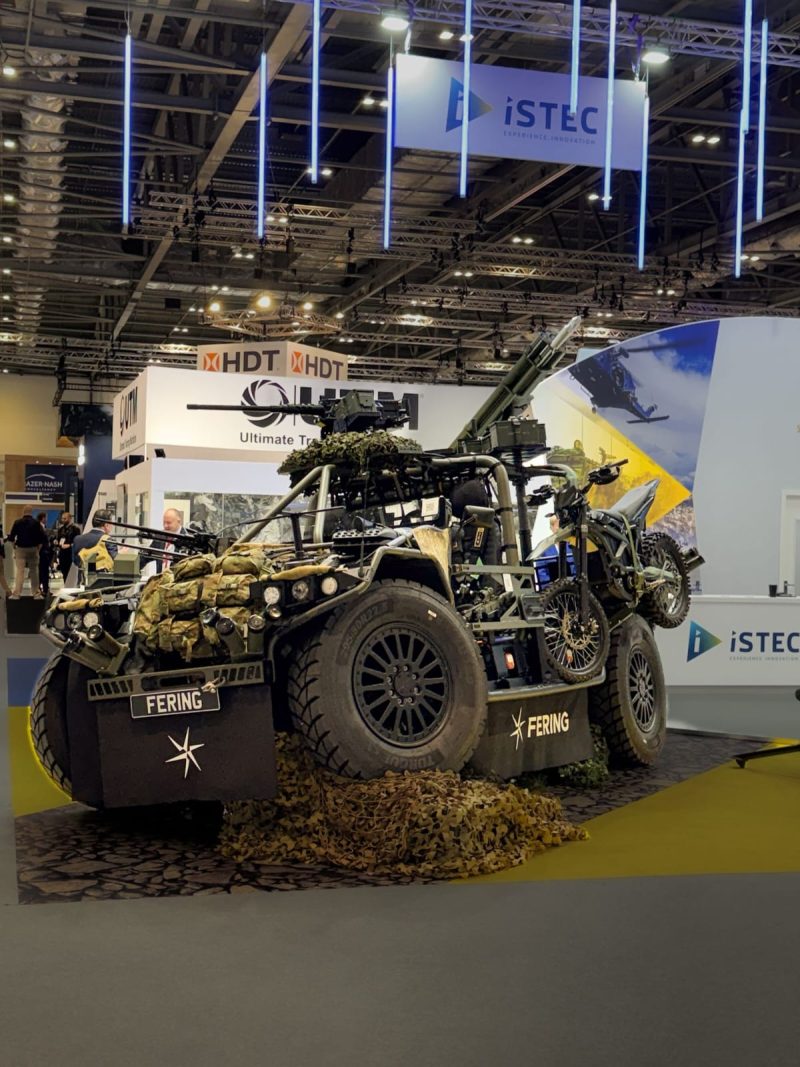
The Pioneer X configured in a light raiding role. Credit: Fering Technologies
The Pioneer X has a central spine with the fuel built into the centre, using carbon fibre and aluminium to keep weight to a minimum. The base configuration weighs 1,650 kg and has a 1:1 ratio for its payload, allowing for 1,650 kg of supplies to be carried and a gross vehicle weight of 3,500 kg. There is a total of 2,320 litres of space on the Pioneer’s load deck, leaving plenty of room for supplies, equipment, and weapons. The vehicle itself is designed with a modular frame that allows it to be extended to a 6×6 or reconfigured to perform multiple roles. The 6×6 configuration adds 1,000 kg of additional payload, along with just 250 kg to the vehicle kerb weight. So, a very low vehicle weight combined with a significant payload provides a very mobile and effective off-road platform. It has a top speed of 130 km/h and a maximum ground clearance of 850 mm, provided by independent active suspension. The suspension has two operating modes, one for roads and another for off-road travel; they allow the ground clearance to be adjusted.
The overall design means that the Pioneer X can climb a 60% gradient, maintain traction on a 50 degree side slope, climb a 0.5 m step, and be submerged up to a depth of 1.5 m – essentially most of the vehicle’s height. The external dimensions enable users to transport it internally using a CH-47 Chinook or CH-53, and it can even fit inside a 20 foot shipping container. As mentioned above, the use of widely available parts is designed to facilitate repair and maintenance in hard to reach places, and the design in any case requires minimal maintenance and servicing. It is common to find these elements within a vehicle’s design, what is less common is the product roadmap for the Pioneer X. Its mobility will be augmented by an autonomous driving system, enabling the vehicle to be sent to collect supplies or evacuate wounded. Fering Technologies has partnered with IDRO Robotics and Overland AI under a grant from the Canadian government to provide an experimental version of the Pioneer X with autonomous capabilities. And most recently, the company has partnered with NTGS to fit the Alakran 81 mm mortar to the vehicle, providing a deployable and mobile indirect fire capability.
And, the vehicle is designed for door panels and armour, keeping soldiers protected from the elements when necessary, but not limiting them to the design constraints of the vehicle as the environmental needs change. The same goes for armour and protection, when speed and mobility are not enough, the Pioneer X can be fitted with blast and ballistic armour, increasing the survivability of its users. Protection is being built into the dashboard and seating of the design to improve blast and ballistic protection using ceramics and advanced flexible materials.
This adaptability is why Fering is positioning itself as a through-life mobility partner. It offers soldiers the platform they need to explore and exploit the unknown, without having to worry about the things that would normally hold them back.
Both of the new Pioneer X variants are here at DSEI, along with the Fering team. You can find the XP 2 at the KIRINTEC stand, N3-330, in the Land zone. XP3 is located at the ISTEC stand also in the Land zone at stand N5-210.